
Red vs green laser pointer (and violet): which colour should you choose?
Green looks brighter, red is the presentation classic and violet makes things glow. The differences explained, with ranges and a choice per use.
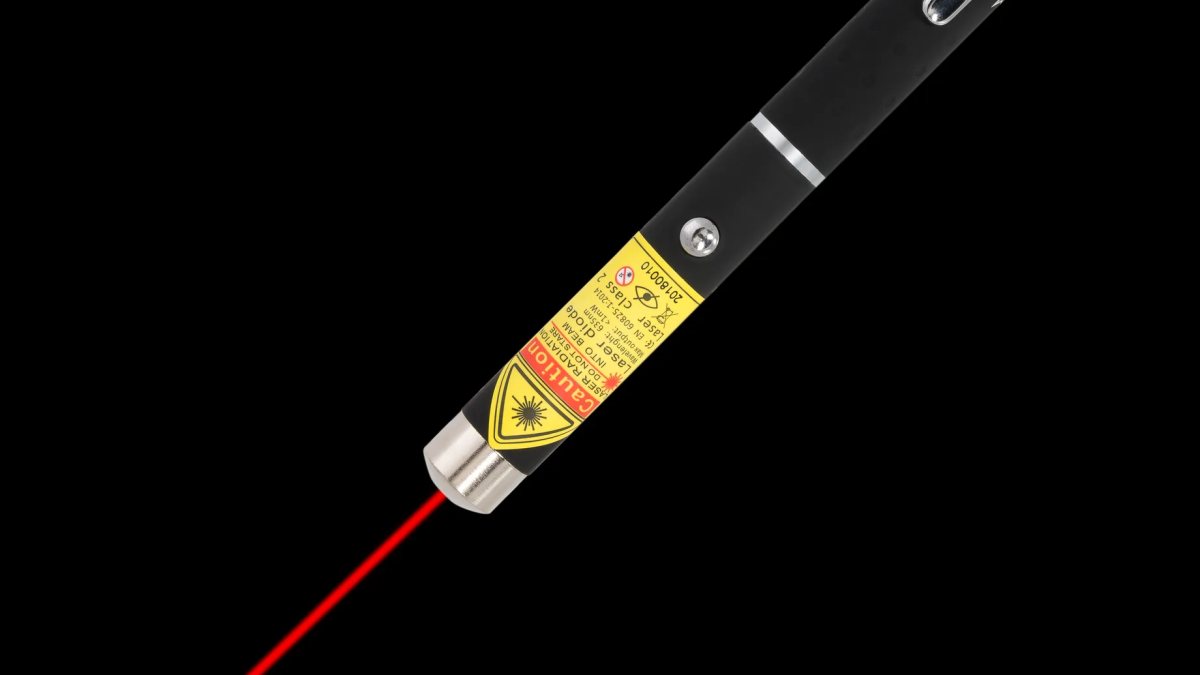
Red, green or violet? When you buy a laser pointer, the colour is the most important choice you make – more important than the brand or the shape. All our lasers have the same class 2 output up to 1 mW, yet they behave completely differently in use. This guide explains why, and which colour suits which job.
Why colours look different at the same output
Your eye is not equally sensitive to all colours. In daylight it is most sensitive to green-yellow light, around 555 nm, and its sensitivity drops towards red at one end and violet at the other. A green laser at 532 nm sits close to that peak. A red laser around 650 nm and a violet laser at 405 nm sit on the flanks of the curve, where the eye needs much more light to see the same brightness.
The practical result: with exactly the same class 2 output, a green dot looks several times brighter than a red dot and far brighter than a violet one. The output is identical; your perception is not.
The colours side by side
| Green (532 nm) | Red | Violet (405 nm) | |
|---|---|---|---|
| Perceived brightness | Very bright | Medium | Dim |
| Indoors | 30 m+ | 30 m | 20 m |
| Daylight | approx. 100 m (shaded surface) | approx. 30–50 m | approx. 10 m |
| Dusk | approx. 300 m | approx. 100–150 m | approx. 50 m |
| In the dark | approx. 1 km | approx. 300–500 m | approx. 200 m |
| Beam visible? | Faintly, in very dark humid air | Hardly | Hardly |
| Best for | Outdoors, stars, birds, big halls | Presentations, indoor pointing | Effect, fluorescent materials |
Green laser pointer: the all-rounder
If you are only buying one laser and you might use it outside, buy green. It is the only sensible colour for pointing out stars, for moving birds on at dusk and for anything at a distance. Indoors the dot is crisp and very easy to follow, which helps in large lecture halls and on big screens.
The downside? In a small, dim meeting room a green dot can feel a bit intense on a slide. Some speakers prefer red there. Our green options: the X1 green laser pen, the X2 with pattern cap, and the rechargeable G3 Pro, G1 Pro and G2 Pro.
Red laser pointer: the presentation classic
Red is the colour most people associate with laser pointers, and for presentations it is still an excellent choice. The dot is clear on a projector screen, calm for the audience and does not overpower your slide. Outdoors, red reaches much less far than green, so it is not the colour for stars or birds.
One more point: people with red-green colour vision deficiency, which is fairly common in men, can find a red dot harder to pick out. If you present to large audiences, green can be the more inclusive choice. Our red options: the M1 red laser pen (650 nm), and the rechargeable R1 Pro and R2 Pro.
Violet laser pointer: the special one
Violet at 405 nm is at the very edge of what we can see, which is why it looks dim. But it has two things going for it: an unusual blue-purple colour, and the ability to make many fluorescent and glow-in-the-dark materials light up. Draw on glow paper in a dark room and the line stays visible for a while. It is a laser for curiosity and fun rather than distance. Our violet options: the Z1 violet laser pen, and the rechargeable V1 Pro and V2 Pro.
Which colour for which job?
| Use | Best colour | Our suggestion |
|---|---|---|
| Presentations in a meeting room | Red | M1 |
| Lectures in a large hall | Green | X1 |
| Pointing out stars | Green | G3 Pro |
| Scaring birds at dusk | Green | G3 Pro |
| Playing with the cat | Red or green | M1 / X1 |
| Glow-in-the-dark fun | Violet | Z1 |
| A bit of everything | All three | Laser pen set |
Three myths about laser colours
"Green lasers are more powerful"
Not in our shop. Every laser we sell has the same class 2 output up to 1 mW. Green only looks brighter because of how your eye works.
"Violet is safer because it looks dim"
No. The eye is less sensitive to violet, so it looks dimmer, but the light still reaches the eye. Treat a violet laser with exactly the same care as any other.
"Red is old-fashioned"
Red is still the most comfortable colour for presentations in normal-sized rooms. It is not outdated; it is simply made for a different job than green.
What about blue, yellow or other colours?
You may come across lasers sold as "blue" or "purple". The 405 nm violet laser is what is usually meant by a purple laser pointer; it looks blue-violet. We sell green, red and violet because these three cover every practical use. If you want to see the differences for yourself, a set is the easiest way: the laser pen set has one pen of each colour, and the Pro set has three rechargeable aluminium models.
Same output, same safety rules
Because all our lasers are class 2 up to 1 mW, the colour does not change the safety rules. A dimmer-looking violet dot is no safer to stare into than green. Never aim any laser at eyes, people, animals' eyes, vehicles or aircraft, and keep lasers away from children. Read laser pointer safety, and for distances in more detail, how far can a laser pointer go. Browse by colour: green, red or purple and violet.
More articles
Blog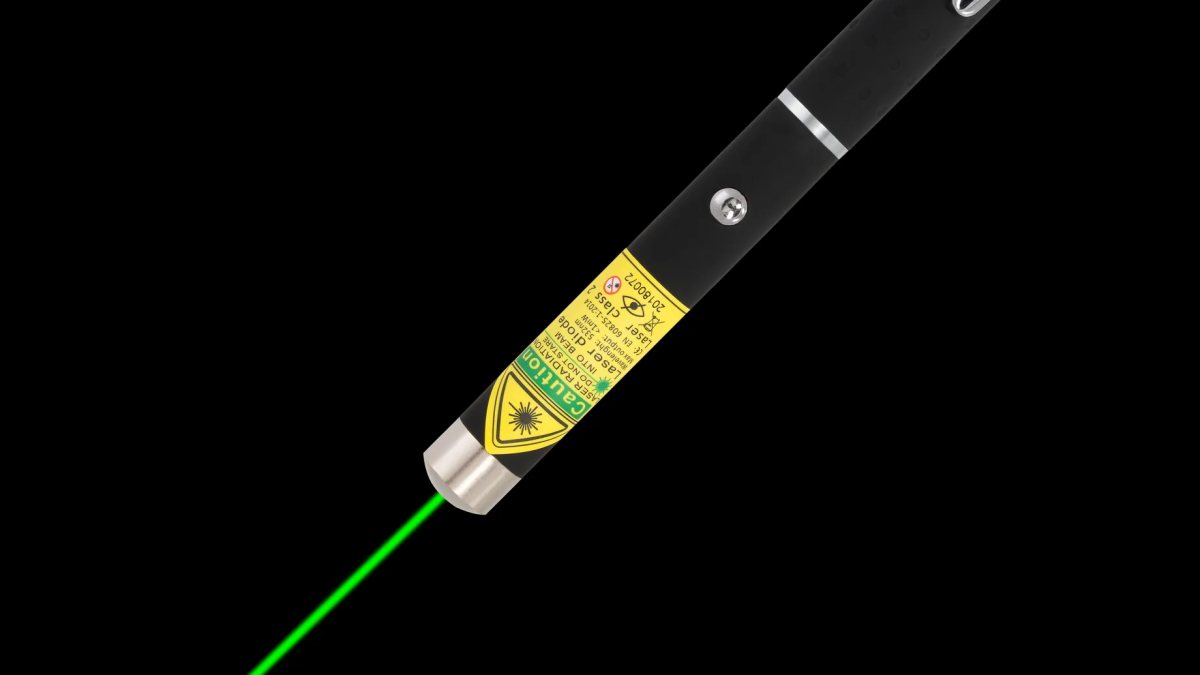
Are laser pens illegal in the UK? Laser pointer law explained
Can you own, buy and use a laser pointer in the UK? What class 2 means, which uses are an offence, and how to…
How bright is a class 2 laser pointer? What up to 1 mW can really do
Wondering whether a class 2 laser is bright enough? What more power would really mean for your eyes and the la…
How far can a laser pointer go? Real distances explained
The beam travels a very long way, but what you can actually see is another story. Realistic, indicative distan…