
How far can a laser pointer go? Real distances explained
The beam travels a very long way, but what you can actually see is another story. Realistic, indicative distances for green, red and violet class 2 lasers.
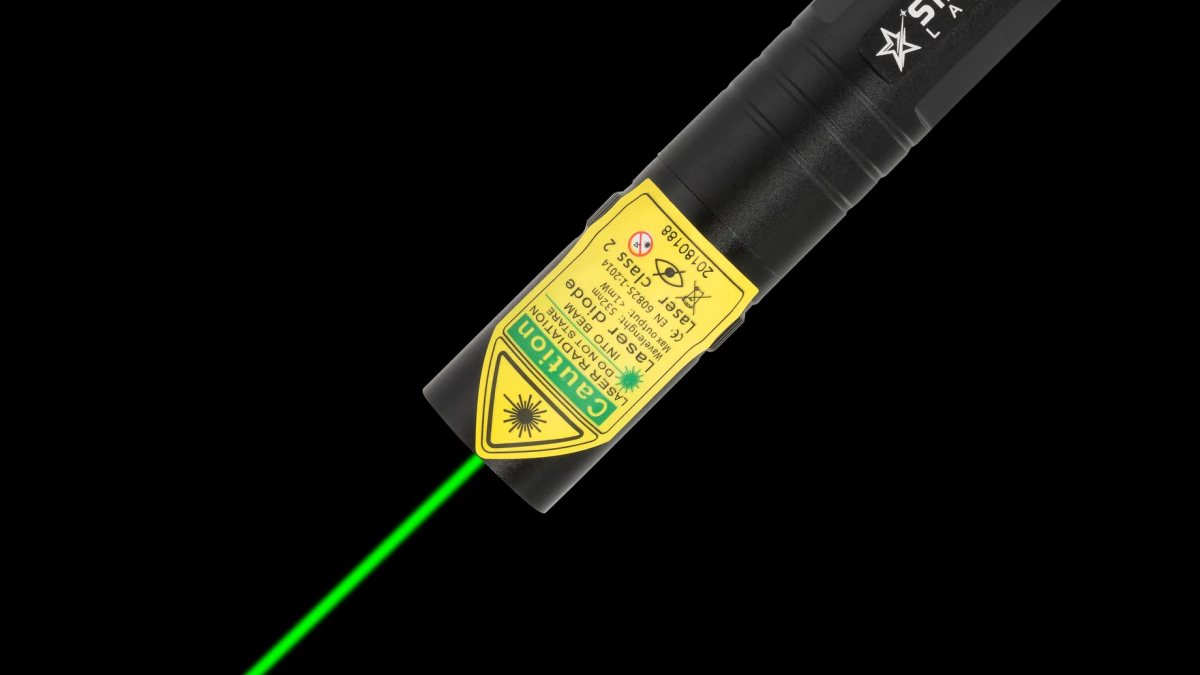
"How far does it go?" is the first question many people ask about a laser pointer. The honest answer has two parts. The light itself travels an enormous distance – far further than you will ever need. What matters in practice is how far away you can still see the dot, and that depends on the colour, the light around you, the weather and the surface you aim at. Let us untangle it.
Beam distance versus visible dot
A laser beam is a narrow, almost parallel bundle of light. It does not simply stop after a few hundred metres; it carries on, gradually spreading and weakening. That is exactly why you must never point a laser at aircraft or towards roads: the light can still dazzle someone long after your dot has become invisible to you.
For you as a user, though, the useful range is the distance at which you can still see the dot on something – a wall, a roof, a tree, the ground. As the beam spreads, the dot gets bigger and dimmer. At some point it fades into the background light. That point is the practical range, and it is what we quote on our product pages.
Indicative ranges for class 2 laser pointers
| Situation | Green 532 nm | Red | Violet 405 nm |
|---|---|---|---|
| Indoors | 30 m+ (whole room or hall) | 30 m | 20 m |
| Daylight | approx. 100 m (dot on a shaded surface) | approx. 30–50 m | approx. 10 m |
| Dusk | approx. 300 m | approx. 100–150 m | approx. 50 m |
| In the dark | approx. 1 km | approx. 300–500 m | approx. 200 m |
These are realistic figures for a steady hand and normal eyesight. You may do better on a perfect night and worse on a hazy afternoon. With green in very dark, humid air, the beam itself is faintly visible too – which is what makes a green laser useful for pointing at stars.
Five things that change the range
1. Colour
The single biggest factor. Your eye is most sensitive to green, so a green dot is visible several times further than red or violet at the same output. More in red vs green laser pointer.
2. Ambient light
A laser dot competes with everything else that is lit. In full sun the competition is fierce; at dusk it is much weaker; at night the dot wins. That is why our daylight figure is for a dot on a shaded surface.
3. The surface
Light, matt surfaces – a whitewashed wall, a pale roof, dry concrete – show a dot best. Dark foliage absorbs light; glass and water reflect it away (and potentially into someone's eyes).
4. The weather
Mist, rain and haze scatter the beam, which shortens the range of the dot. Paradoxically, a little humidity helps you see the beam of a green laser at night, because the light scatters off tiny droplets.
5. Your hand and your eyes
At a few hundred metres, a tiny tremor moves the dot many metres. Brace your arm on something solid. And give your eyes time to adapt to the dark: after ten minutes or so you will see much more.
Test the range yourself
Curious what your own laser does? Try this on a clear evening. Pick a light-coloured wall or building at a known distance – a map app will tell you how far away it is – and make sure there are no roads, windows or people in the line of the beam. Start at dusk and repeat once it is fully dark. You will see the difference that ambient light makes, and how much easier the dot is to spot once your eyes have adapted. Compare a green and a red laser side by side if you have both, and the effect of colour becomes obvious immediately. Never test towards houses, traffic, airfields or open water.
What about lasers that promise many kilometres?
You will see listings claiming ranges of many kilometres. Those are higher-power lasers – not intended for sale to the public in the UK – or simply exaggerated claims. A high-power beam may indeed be visible further, but the price is a laser that can damage eyes in a fraction of a second, including by reflection. For pointing, stargazing and bird control, a class 2 green laser that shows a dot at approx. 1 km in the dark covers almost everything. We explain the trade-off in our class 2 brightness guide.
Which laser for long distances?
Go green. The G3 Pro is our most chosen long-range model: rechargeable, lockable and solid. The G2 Pro gives you the same green dot in a 12 cm body. On a budget or prefer AAA batteries? The X1 green laser pen. Practical guides: long range laser pointer, laser pointer for astronomy and laser pointer for scaring birds.
Range and responsibility
The further a laser reaches, the more you need to think about what is behind your target. Before you switch on outdoors, check for roads, houses, people and aircraft in the line of the beam, and switch off if anything comes into view. Never aim at eyes, people, animals' eyes, vehicles or aircraft. Shining a laser at a vehicle or aircraft is a criminal offence in the UK. Read laser pointer safety and laser pointer law in the UK.
More articles
Blog
Are laser pens illegal in the UK? Laser pointer law explained
Can you own, buy and use a laser pointer in the UK? What class 2 means, which uses are an offence, and how to…
How bright is a class 2 laser pointer? What up to 1 mW can really do
Wondering whether a class 2 laser is bright enough? What more power would really mean for your eyes and the la…
Red vs green laser pointer (and violet): which colour should you choose?
Green looks brighter, red is the presentation classic and violet makes things glow. The differences explained,…